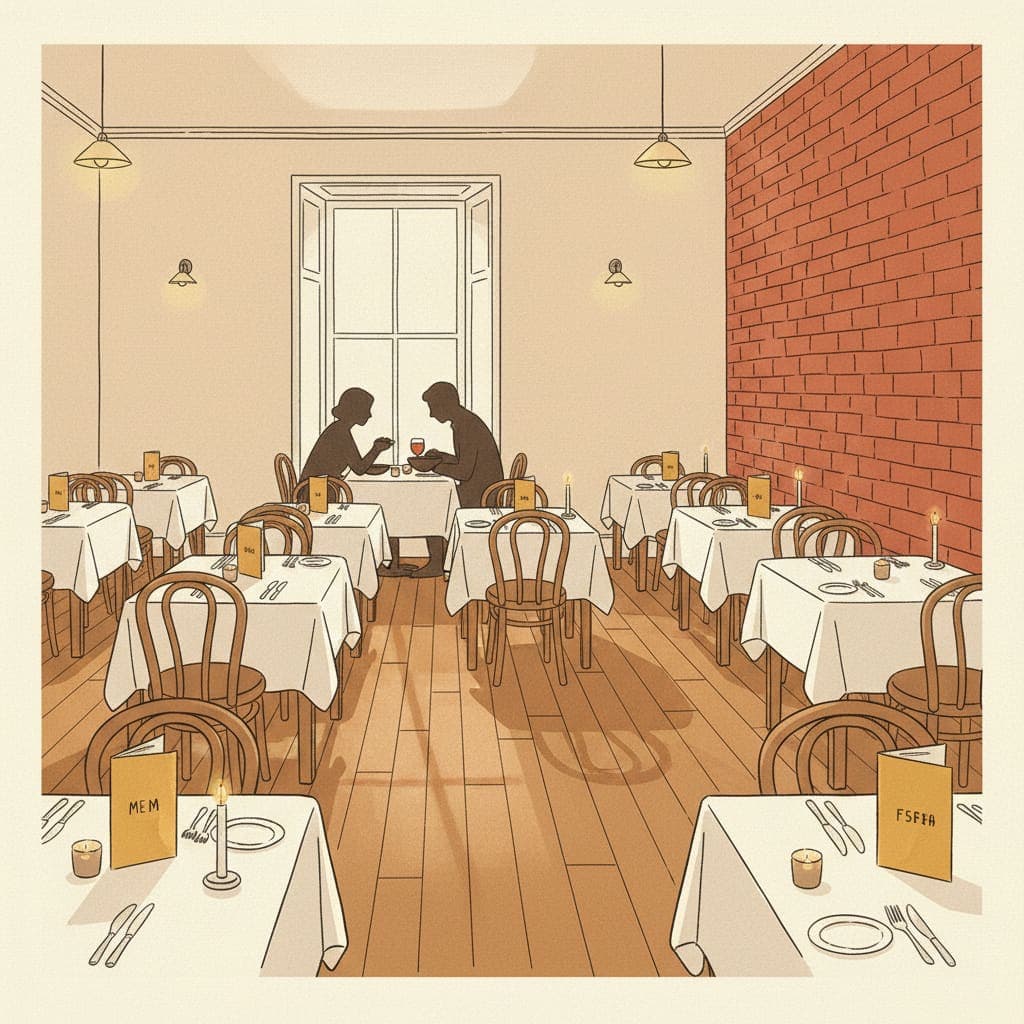
If your Tuesday and Wednesday dinner service is running at 30–50% of weekend capacity, you're not unusual — most UK independent restaurants live that pattern. The four levers that actually move midweek covers are: a midweek-only set menu with its own landing page, Meta retargeting to people who've already shown interest, Google search ads tuned to local "tonight" intent, and an email or SMS sequence to past customers. Done together for six to eight weeks, owners typically see midweek covers rise by 15–30%. None of these levers require a new website. None require a celebrity chef. All four are running by the end of the second week.
This guide walks through the maths behind each lever, the order to run them in, and a worked 4-week example. It assumes you already have a Google Business Profile, an Instagram account, and a basic restaurant website — if you don't, start with our pillar on ranking on Google Maps first.
Why Tuesdays and Wednesdays are dead — and why that's a fixable problem
Out-of-home eating in the UK is heavily skewed to Friday, Saturday and Sunday. Lumina Intelligence's eating-out tracker shows the average UK consumer eats out 1.5 times per week, and around 60% of those occasions land Thursday–Sunday.[1] OpenTable's UK booking data tells the same story from the demand side — seated diners on Saturdays consistently run 2–3× the weekday average.[2]
That skew is sociological, not personal to your restaurant. Pay cycles, school nights, and the British habit of treating eating out as a weekend reward all push demand into Friday–Sunday. The good news: midweek demand isn't absent. It's just not searching for the same thing. People eating out on a Tuesday are doing it for a different reason — a date that didn't fit the weekend, an after-work drink that turned into dinner, a family member visiting, a midweek treat. They convert differently. They book later. They respond to different messaging.
The four levers below all work on midweek demand specifically. They will not transform a dead room into a Saturday-night room. They will reliably move it from 30% capacity to 50–65% — which on most independents is the difference between a midweek loss and a midweek profit.
Lever 1 — A midweek-only set menu with its own landing page
The most reliable midweek lever is a Tuesday/Wednesday-only set menu. Two or three courses at a fixed price 15–25% below your à la carte average, available only on those two days, bookable through your normal reservation system.
This works for three reasons. First, it gives people a reason to come on a Tuesday — "the set menu is only Tues/Wed" is a complete answer to "why now?" Second, it makes the booking decision easier — the price is known, the menu is fixed, no surprises. Third, it lets you pre-prep more aggressively, which protects your kitchen on a slow night when ordering tickets one-by-one is expensive.
The mistake most restaurants make is hiding the set menu inside the main menu PDF. The fix: a dedicated page on your website at /menu/midweek-set-menu with the menu, the price, the days it runs, photos of two or three dishes, the booking widget, and a single H1 like "Midweek set menu — Tuesdays & Wednesdays from £24." Then every other channel — Google Business Profile, Instagram bio, Meta ad, email — links to that page, not your homepage.
A dedicated landing page also unlocks Google. Google's local ranking signals weight relevance heavily — having a page that literally says "midweek set menu" makes you eligible to rank for that exact search, which your homepage isn't.[3] A page that took an afternoon to build can pick up steady organic traffic for as long as you keep it published.
This week: decide the price and the dishes, take three good photos, publish the page, link it from your booking widget, your Google Business Profile menu attachment, and your Instagram bio.
Lever 2 — Meta retargeting to people who never booked
The single highest-ROI ad most independent restaurants can run is a Meta retargeting campaign aimed at people who visited your website or your Instagram profile in the last 30 days but never booked.
These are the warmest leads you have. They've already seen your brand, looked at your menu or your feed, and decided not to book — usually because they got busy, not because they didn't like you. A reminder ad timed for Monday morning ("Quiet table this Wednesday? Set menu from £24") catches them at the point where the week's plans are being made.
Cost mechanics: in most UK cities, retargeting CPMs sit at £4–£8 (lower than cold prospecting). At a £5 daily budget, you'll reach 250–500 warm people per week. Of those, 1–3% will click. Of those, 5–15% will book. That's the maths behind "£35/month buys 4–8 incremental midweek covers" — modest in absolute terms, excellent in ROI, and the click rate compounds as your audience grows.
The setup is two things: a Meta Pixel installed on your website (10-minute job, your website builder can do it), and an audience defined as "people who visited the site in the last 30 days but didn't visit the thank-you-for-booking page." Run one ad creative against that audience. Refresh it every fortnight.
For a deeper dive on the maths and budget tiers, see our guide on Google Ads vs Just Eat — the retargeting maths is similar even though the channel is different.
Lever 3 — Google ads tuned for midweek intent
Google search ads work differently from Meta retargeting. Meta catches people who already know you. Google catches people deciding right now where to eat tonight.
The key for midweek is keyword choice and ad timing. Most restaurants set up Google ads against generic terms ("restaurant near me", "[cuisine] near me") and bid the same all week. That gets crushed on Friday and Saturday by chains with bigger budgets, and wastes spend midweek where there's less competition.
The smarter setup: bid on midweek-specific intent terms only, only on Tuesday and Wednesday, and only between 11am and 7pm. Examples of queries that signal genuine midweek intent: "set menu near me", "midweek dinner [town]", "where to eat tonight [town]", "restaurants open now", "early bird menu [town]". CPCs on these are typically £0.80–£1.50 in UK cities outside London, versus £2.50+ for "restaurants near me" on a Saturday.[4]
A £100/month budget at £1.20 CPC buys roughly 83 clicks per month, or 21 clicks per Tuesday/Wednesday session over four weeks. At a 4–6% booking rate (typical for high-intent local queries), that's 3–5 incremental bookings per week — usually 2–4 covers each. The maths is tight but positive on a £30–£50 cover.
If you operate in Birmingham, Manchester or another major city, expect CPCs at the higher end of that range and adjust your budget accordingly.
Lever 4 — Email and SMS to people who've already booked once
Your past customers are the cheapest acquisition channel you have. If they liked you enough to come once, getting them back midweek is the lowest-friction sale in your business.
The mechanics are simple. Every customer who books leaves their email address (most reservation systems collect it by default). Once a month, send them a short, useful email — not "BOOK NOW," not "WE MISS YOU," but something with a real reason: "We're running a midweek set menu through October — Tuesdays & Wednesdays, three courses for £28. Want to book the same table you had last time?"
Expected response rates: a clean, well-segmented email list of past restaurant customers typically opens at 35–45% (well above the 21% UK retail average reported by Mailchimp benchmarks), and converts 2–5% of openers into a booking within seven days. On a list of 800 past customers that's 250–350 opens and 5–17 bookings — for the cost of an email send (under £20/month on most platforms).
SMS sits in the same place but with different mechanics. UK SMS open rates run at 95–98% within three minutes of delivery. Send rates are lower than email (you can send fewer SMS before customers opt out), but the response per message is roughly 3–5× higher. Reserve SMS for the genuinely time-sensitive — "Cancellation tonight, table free for 7pm, reply YES to book."
A critical caveat: you must have consent under the UK's PECR (Privacy and Electronic Communications Regulations). The reservation form is the right place to collect it — a checkbox saying "I'm happy to receive occasional booking offers from [restaurant name]" gives you a clean opt-in.[5] Don't import a contacts CSV from your phone and start emailing. The ICO has been increasingly active on hospitality complaints.
For more on getting your reservation database working hard, see our piece on how to get more Google reviews — same database, two different uses.
The order to run them in
Owners often try to launch all four levers in the same week. Don't. Each lever needs the previous one to be working before it's worth running. The order:
- Week 1 — landing page. No ads work without a page to send them to. Build the set menu page first.
- Week 2 — email to past customers. Cheapest, fastest, warmest audience. Send the first email the day the landing page goes live.
- Week 3 — Meta retargeting. Once you've had a week of new traffic to the landing page, you have an audience worth retargeting against.
- Week 4 — Google ads. Last because it's the most expensive per click. Wait until you've seen the conversion rate from the landing page before paying for cold traffic to it.
Run all four together from week 4 onwards. Measure weekly. The thing you're tracking is bookings on the midweek set menu specifically, not total covers — which makes attribution clean.
What this looks like in practice — a 4-week worked example
Take an independent UK restaurant with 60 covers per service, currently running 22 midweek covers on a Tuesday and 25 on a Wednesday. Annual midweek revenue at £35 per head is roughly £85,000 across the two nights.
| Week | What's live | Midweek covers | Notes |
|---|---|---|---|
| 0 | Status quo | 22 / 25 | Baseline |
| 1 | Set menu page live | 22 / 25 | No marketing change yet — just the page indexed |
| 2 | Set menu + email to past customers | 28 / 31 | Email drove ~12 incremental bookings across the two nights |
| 3 | Set menu + email + Meta retargeting | 32 / 34 | Retargeting ad live for 4 days; ~£25 spend, 9 bookings attributed |
| 4 | All four levers | 38 / 41 | Google ads added; full mix now running |
| 8 | All four levers, optimised | 41 / 44 | Audiences warmer, repeat bookers starting to compound |
By week 8, midweek capacity has moved from 39% (47 covers across two nights) to 71% (85 covers). At £35 per head, that's £1,330 of incremental midweek revenue per week — £5,320 per month against a marketing spend of roughly £350. The numbers will vary by city, cuisine and price point, but the pattern is consistent: small, sustained, layered effort moves midweek demand in a way that one-off social posts never do.
What we won't promise
We won't promise a specific number of incremental covers. Restaurants vary too much — your kitchen capacity, your cuisine, your price point, your existing brand strength, your city's competitive intensity all change the maths. What we will promise: a measurable, attributable system, run weekly, with honest reporting. If after eight weeks the numbers aren't moving, we'll tell you what to change — and if the answer is "you don't need us, just keep doing the email part yourself," we'll say that too.
The honest summary
- Midweek demand exists. It books later, responds to different messaging, and rewards a dedicated landing page.
- Four levers, in order: set menu page → email to past customers → Meta retargeting → Google ads on midweek-specific intent.
- £300–£400/mo of total marketing spend is the floor that makes the maths work for most UK independents.
- Track bookings on the midweek set menu specifically — that's how you'll know it's working.
- Compound effort beats one-off promotions. Eight weeks is the right horizon.
If midweek is the problem you want to solve next, the set menu page is the first weekend of work. Everything after that is layering. None of it requires rebuilding your website or hiring more staff.
Sources & further reading
- Lumina Intelligence — UK Eating Out Market Report 2024
- UKHospitality — Quarterly Tracker, hospitality sales by daypart
- OpenTable — State of the Industry 2024 (UK)
- BrightLocal — Local Consumer Review Survey 2024
- ICO — Direct marketing under PECR (UK)
- Google — Local search ranking signals (Google Business Profile help)
We help UK restaurants and takeaways grow online. Get in touch for a free audit.