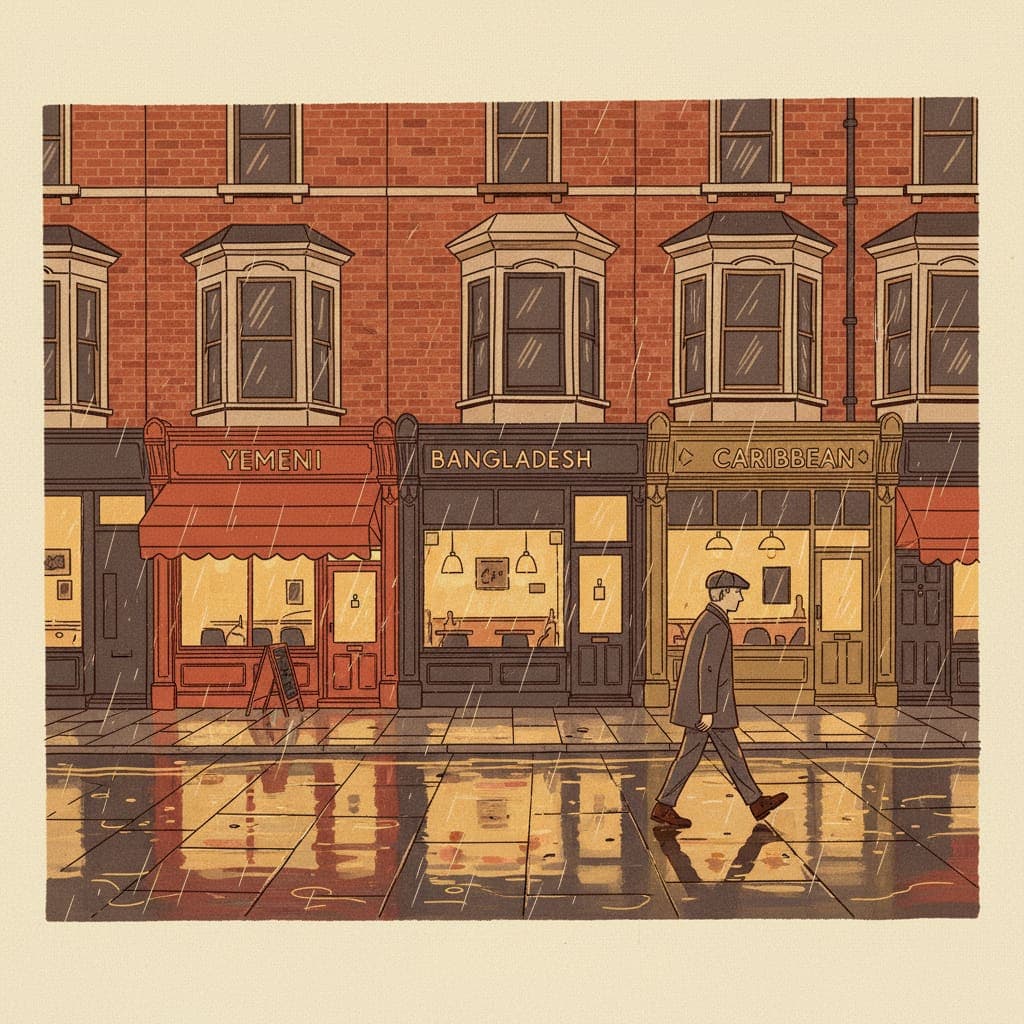
What we see in the Liverpool market
Liverpool's independent food economy has grown faster than most UK cities outside London over the last five years. The Baltic Triangle dine-in scene barely existed in its current form a decade ago. Lodge Lane and Granby have shifted from quiet corridors to genuinely competitive local-food markets. The student belt around Smithdown Road and Wavertree has gained density. The customer base is younger, more food-engaged and more willing to try new places than the UK average.
Average takeaway ticket sizes in L-postcodes typically run £14–£24 — broadly similar to Manchester and Bradford, lower than London. Average dine-in spend in the Baltic, in Bold Street's better restaurants, and in the West Africa-meets-Caribbean corridors of Granby and Toxteth, varies widely; the £20–£35 dine-in band covers most independent operators outside the higher-end L1 venues.
A few things follow:
- Google Maps three-pack is genuinely contestable in the takeaway corridors. Many L7, L8 and L15 kitchens have under-maintained Google Business Profiles, which means a steady weekly routine on photos, posts and review responses moves rankings faster here than in higher-density London markets. Our walkthroughs on why your restaurant might not show on Google Maps and how to rank a restaurant on Google Maps cover the foundations.
- The student calendar shapes demand more than in most UK cities. Around 70,000 students across the University of Liverpool, Liverpool John Moores and Hope swing the L7 / L15 / L17 areas 30–50% on weekly order volume between term-time and the long summer break. Marketing should plan for it.
- The Baltic Triangle is essentially its own market. Brand-led search, Instagram, press, and event-led footfall do most of the work — Local SEO and aggregator listings matter less. A different playbook than the takeaway corridors a couple of miles away.
How Liverpool customers find restaurants
Three patterns we see across kitchens we work with in L-postcodes:
Google Maps does most of the discovery work outside the centre. A customer in Toxteth, Wavertree or Walton searching "curry near me", "halal takeaway" or "pizza delivery" sees the local pack three-spot before anything else. Owning one of those slots is the highest-leverage move a Liverpool takeaway can make — and it's achievable, because so many established kitchens have neglected their listings.
Instagram is heavily used for new-restaurant discovery in the Baltic, on Bold Street, and around the docks. Liverpool's customer base, particularly under-35, will check a restaurant's Instagram before deciding — recent posts, recent stories, whether the place still feels alive. A profile that hasn't posted in eight weeks is a real silent killer. Our Instagram for restaurants UK guide is the starting point.
Reviews compound visibly. A consistent review-collection programme typically moves a Liverpool takeaway from 30 reviews to 150 in 12–18 months — visibly climbing the local pack. The competitive bar in L-postcodes is meaningfully lower than in central Manchester or London, so the gain is more visible.
Delivery-app behaviour splits sharply by area. L1 and L7 (student-heavy) lean Deliveroo and Uber Eats with high cyclist-courier density. The takeaway corridors in L8, L15 and L13 lean more towards Just Eat and longer delivery distances. We've covered the trade-offs in should I leave Just Eat and go direct and how to get more orders on Just Eat.
Realistic ad budgets in Liverpool
A few benchmarks from campaigns we run in the city:
- Standard L-postcode takeaway zones work at £10–£18/day Google Ads spend. £350–£550/month produces 280–500 attributable clicks, which converts to roughly 18–30 attributable orders depending on landing page and offer.
- Baltic Triangle and Bold Street dine-in typically need £20–£30/day because brand-led search and event-week competition push CPCs up.
- Match days at Anfield and Goodison (and especially European nights at Anfield) shift delivery demand inside a 2–3 mile radius of each ground. We plan around the fixture list for affected clients.
For a wider view of when paid even makes sense, see is Google Ads worth it for takeaways and our breakdown on Google Ads vs Just Eat.
Postcodes we work in
- L8 (Toxteth / Granby / Princes Park / Lodge Lane) — dense Yemeni, Somali, Bangladeshi and Caribbean independent scene, very contestable Google Maps local pack
- L7 / L15 (Wavertree / Smithdown Road) — student-heavy, aggregator-dominated, term-time-sensitive
- L17 (Aigburth / Sefton Park) — mid-range dine-in and takeaway, suburban
- L1 / L3 / L8 Baltic (City centre / Ropewalks / Baltic Triangle) — dine-in, Instagram-led brands, press and influencer coverage matter alongside SEO
- L4 / L5 / L6 (Anfield / Everton / Kensington) — match-day-sensitive, mixed Pakistani / Polish / Caribbean takeaways
- L13 / L14 (Old Swan / Knotty Ash) — established suburban takeaway market
- L18 / L19 (Mossley Hill / Allerton / Garston) — quieter higher-end suburban dine-in
- L36 / L25 (Huyton / Childwall edge) — outer Merseyside delivery zones
What we typically work on for Liverpool kitchens
For a Lodge Lane, Smithdown Road or Wavertree takeaway the highest-leverage starting point is a properly maintained Google Business Profile plus Local SEO — Liverpool's takeaway corridors have genuinely contestable local packs, and consistent weekly work tends to register fast. For Baltic Triangle, Bold Street and city-centre dine-in restaurants the playbook shifts: an Instagram-led social media programme, a fast conversion-led restaurant website, and modest Google Ads on brand and cuisine terms. Most clients also benefit from refreshed menu and photography work — outdated photography is one of the most common things we tighten up in audits.
What we don't promise
We don't promise specific revenue lifts, ranking positions, or order-volume targets. Liverpool is varied enough — Lodge Lane, the Baltic Triangle, Anfield and Allerton are essentially four different economies — that any agency claiming a guaranteed outcome should be questioned.
What we do commit to: a written 90-day plan, monthly reporting, transparent pricing, and a clear pause or pivot if it isn't working by month four. If we look at your kitchen and think you'd benefit more from fixing one or two specific things yourself — sorting your GBP photos, replying to your reviews properly, posting once a week on Instagram — than from hiring an agency, we'll say so.