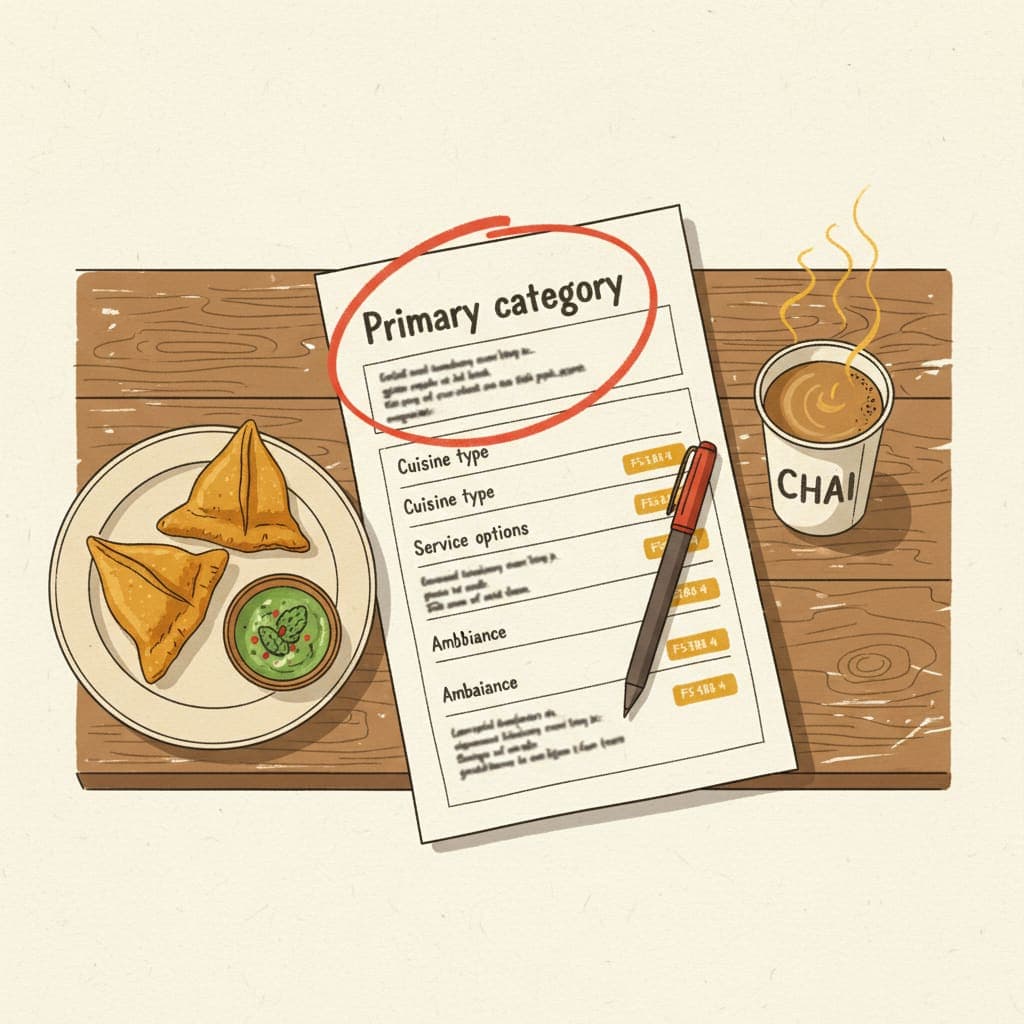
If you've ever wondered why a competitor with worse food and fewer reviews outranks you for "indian takeaway near me", the answer is almost always one of two things — reviews, or categories. Reviews compound slowly. Categories you can fix in 90 seconds.
This guide walks through the specific Google Business Profile (GBP) categories that work for UK restaurants and takeaways, broken down by cuisine. It covers what to set as your primary, what to add as secondary, the mistakes we see weekly during client audits, and how to change categories without losing existing ranking. Written for independent owners, not enterprise chains.
The honest one-line answer
Set your primary category to the most specific cuisine match available — e.g. "Indian restaurant", "Pakistani restaurant", "Turkish restaurant", "Pizza restaurant", "Fish and chips restaurant". Then add between 4 and 9 secondary categories covering: a second cuisine if you genuinely serve it, "Takeaway", "Delivery service", and any specialist dish you're known for ("Biryani restaurant", "Kebab shop", "Halal restaurant").
That's the rule for ~90% of UK takeaways. The rest of this post is the specifics, the exceptions, and the traps.
Primary vs secondary — the rule that matters
Google treats your primary category as roughly 4–5× more influential for ranking than any single secondary category. Get the primary right and the rest is fine-tuning.
What Google's documentation says about primary categories:[1]
"Choose a primary category that describes your business overall. Pick additional categories for other services you offer."
In practice, primary works like this:
- Your primary defines the "what is this business" answer Google gives to AI search, Maps queries, and the local pack
- It controls which keyword categories you compete for ("indian restaurant near me" is one keyword class, "takeaway near me" is a much broader and less qualified one)
- Changing your primary category can move your ranking by 5–15 positions overnight — both up and down
Secondary categories are additive, not subtractive. Adding 9 secondaries doesn't hurt. Adding zero leaves money on the table.
Rule of thumb: primary is who you are, secondaries are everything else you do.
The complete UK restaurant category list (the ones that actually exist)
Google's full category list runs into the thousands[5], but only a small subset apply to UK takeaways and restaurants. Here are the categories that exist and are worth picking from:
Cuisine-specific (use these as PRIMARY where they match):
- Indian restaurant
- Pakistani restaurant
- Bangladeshi restaurant
- South Indian restaurant
- North Indian restaurant
- Sri Lankan restaurant
- Turkish restaurant
- Mediterranean restaurant
- Middle Eastern restaurant
- Lebanese restaurant
- Afghan restaurant
- Persian restaurant
- Chinese restaurant
- Cantonese restaurant
- Sichuan restaurant
- Thai restaurant
- Vietnamese restaurant
- Japanese restaurant
- Korean restaurant
- Italian restaurant
- Pizza restaurant
- Greek restaurant
- Caribbean restaurant
- Jamaican restaurant
- African restaurant
- Nigerian restaurant
- Ethiopian restaurant
- Mexican restaurant
- American restaurant
- Hamburger restaurant
- Fried chicken takeaway
- Fish and chips restaurant
- Polish restaurant
- Halal restaurant
- Kosher restaurant
- Vegetarian restaurant
- Vegan restaurant
Dish-specific (good as secondaries):
- Biryani restaurant
- Curry restaurant
- Tandoori restaurant
- Kebab shop
- Doner kebab restaurant
- Shawarma restaurant
- Sushi restaurant
- Noodle shop
- Dim sum restaurant
- Falafel restaurant
Format / channel (most takeaways need at least one of these as secondary):
- Takeaway
- Delivery restaurant
- Delivery service
- Meal delivery
- Meal takeaway
- Family restaurant
- Restaurant
We list "Restaurant" last deliberately — see the next section.
Indian, Pakistani, Bangladeshi — the specific picks
This is the largest single category of UK takeaways and the one with the most miscategorisation. Most owners default to "Restaurant" or "Indian restaurant" and stop there.
Primary recommendation:
- If your menu is broadly Indian / Mughlai (most curry houses) → Indian restaurant
- If it's specifically Pakistani / Punjabi / North Indian style → Pakistani restaurant
- If it's Bangladeshi / Sylheti (think traditional UK "Indian" curry house run by Bangladeshi families) → Bangladeshi restaurant is more specific, but Indian restaurant gets searched more
- Family-run chaat / dosa / South Indian → South Indian restaurant
Secondaries to add:
- Takeaway
- Delivery restaurant
- Halal restaurant (if you are — most UK Asian takeaways are)
- Curry restaurant
- Biryani restaurant (if it's a menu specialism)
- Tandoori restaurant (if you have a tandoor)
- Family restaurant (if you serve dine-in)
- Vegetarian restaurant (if you have a strong veg menu)
A common case where the cuisine and the category compete: a Bangladeshi-owned curry house serving a fairly standard UK Indian menu. Pick "Indian restaurant" as primary because that's how customers search. Add "Bangladeshi restaurant" as a secondary — it picks up the small but high-intent traffic searching specifically for Bengali food.
Turkish, Afghan, Middle Eastern — what to pick
For Turkish kebab shops, the right primary depends on what dominates your menu:
- Mainly grilled meats, kebabs, mixed grills → Turkish restaurant
- Primarily doner / shawarma / wraps → Kebab shop as primary, Turkish restaurant as secondary
- Lebanese / mezze-focused → Lebanese restaurant
- Persian rice dishes, kebabs → Persian restaurant
- Afghan mantu, qabuli pulao → Afghan restaurant
Secondaries to add for most kebab/Turkish shops:
- Doner kebab restaurant
- Kebab shop
- Mediterranean restaurant
- Halal restaurant
- Takeaway
- Falafel restaurant (if on menu)
- Shawarma restaurant (if a specialism)
A specific point worth flagging: "Kebab shop" outranks "Turkish restaurant" for the search "kebab near me" but loses on "Turkish restaurant near me". If your primary is "Turkish restaurant", definitely add "Kebab shop" as a secondary — and vice versa.
Pizza, burgers, fried chicken — the British high street trio
These are the most competitive categories on the UK high street. Get the primary right or you get buried.
Pizza:
- Primary: Pizza restaurant (not "Italian restaurant" unless you genuinely serve pasta, antipasti and a wider Italian menu)
- Secondaries: Takeaway, Delivery restaurant, Italian restaurant (if you serve Italian sides), Family restaurant
Common error: an independent pizza shop sets primary to "Italian restaurant" because it sounds more upmarket. Pizza-specific searches outweigh "Italian restaurant" searches 10:1 on most UK high streets — you've just halved your visibility.
Burgers:
- Primary: Hamburger restaurant
- Secondaries: Takeaway, Delivery restaurant, American restaurant, Fast food restaurant
Fried chicken / chicken shops:
- Primary: Fried chicken takeaway (this is the literal category Google uses for UK chicken shops)
- Secondaries: Takeaway, Delivery restaurant, American restaurant, Halal restaurant (if applicable), Family restaurant
If you serve all three — burgers, chicken, pizza — you have a categorisation problem. Pick the one that dominates revenue as your primary; the others go as secondaries. Trying to rank for all three with "Fast food restaurant" as primary is weaker than picking one cleanly.
Fish & chips, kebab shops — the uniquely UK categories
Fish and chips:
- Primary: Fish and chips restaurant (yes, that's the literal category)
- Secondaries: Takeaway, Delivery restaurant, British restaurant, Family restaurant
- Avoid: "Seafood restaurant" — that gets sit-down seafood searches, not chippy traffic
Pure kebab shop (doner-led, minimal dine-in):
- Primary: Kebab shop
- Secondaries: Doner kebab restaurant, Turkish restaurant (if cuisine matches), Takeaway, Halal restaurant
Chicken and chips combo (UK Afro-Caribbean / West African):
- Primary: Fried chicken takeaway if chicken-dominant; Caribbean restaurant or Nigerian restaurant if cuisine-led
- Secondaries: Takeaway, Halal restaurant (if applicable)
These uniquely-UK formats are the ones most international agency advice gets wrong. The categories exist; use them.
The category mistakes we see weekly
From auditing 100+ UK independent takeaways' GBP listings, these are the recurring mistakes:
- Primary set to generic "Restaurant". Strongest example of leaving money on the table. "Restaurant" competes against every cuisine in your postcode for every food search. Always lose to specialists.
- Primary set to "Takeaway" or "Meal takeaway". Same problem — broad, undifferentiated, loses to cuisine-specific competitors.
- No secondary categories at all. A surprising number of profiles have one primary and nothing else. You're not getting "halal", "biryani", "delivery" searches you'd otherwise capture.
- All 10 secondary slots used on near-duplicates. "Indian restaurant", "South Indian restaurant", "North Indian restaurant", "Punjabi restaurant", "Curry restaurant", "Tandoori restaurant"… stuffing duplicates dilutes the signal. Pick 4–6 high-signal ones, not 10 redundant ones.
- Cuisines they don't actually serve. Adding "Italian restaurant" because pizza is on the menu, or "Chinese restaurant" because there's a sweet-and-sour chicken option. Google's guidelines explicitly ban this and reviewers report it.[3]
- "Hotel" or "Lodging" categories added for cafés inside hotels. This is what Google calls a "feature misuse" and can cause suspensions.
If you have any of these on your current profile, fix them before you do another SEO thing. Categories are the single fastest GBP lever.
How Google uses categories to rank you
Categories feed Google's three local ranking signals: relevance, distance, prominence.[2] Specifically:
- Relevance — categories tell Google what searches you're relevant for. "Indian restaurant" makes you relevant for "indian takeaway near me". Without that category, you're not.
- Distance — only matters once relevance is established. Wrong category = no distance check = you don't appear in the local pack.
- Prominence — review count, link authority, mentions. Categories don't feed prominence directly.
Categories are also how AI search engines (ChatGPT search, Perplexity, Bing Copilot) classify your business when answering questions like "best curry house in [city]". An Indian restaurant categorised as "Restaurant" is invisible to those queries.
This compounds with the rest of the local SEO playbook — covered in how to rank your restaurant on Google Maps — but starts here. Without the right primary category, the other 80% of the work doesn't compound.
How to change categories without breaking your ranking
The fear most owners have: "if I change my category, will I lose existing ranking?"
Honest answer: possibly, briefly. Google sees a primary category change as a significant business attribute change. There's usually a 7–21 day re-assessment period where your rankings can dip. After that, if the new category is more accurate and better-targeted, you'll net rank higher than before.
What we do with client GBPs:
- Pick a quiet trading week (avoid Friday/Saturday peak or run-up to a known busy period like Eid, World Cup, Christmas)
- Make ONE category change at a time. Don't swap primary and add 5 secondaries on the same day — Google flags coordinated edits.
- Wait 7–14 days. Check ranking before adding the next change.
- Keep notes — date, what changed, what your ranking did. Builds a feel for how Google treats your specific profile.
If your current primary is "Restaurant" and you want to move to "Indian restaurant", expect 7–10 days of choppiness, then a meaningful uplift if "Indian restaurant near me" is a more searched query in your area than the generic "restaurant near me" (it almost always is).
The exception: if your profile has been suspended in the last 12 months, get advice first. Significant category changes on rehabilitated profiles can trigger re-suspension. The Google Business Profile management work we do includes the suspension diagnostic.
FAQ
How many secondary categories can I add? Google allows up to 9 secondary categories on top of the 1 primary. Most independents don't use them all and shouldn't try to — 4–6 high-signal ones is the sweet spot.
Can I have two primaries? No. One primary only. If your business genuinely spans two cuisines (a Turkish-Lebanese mezze house, for example), pick the one with higher local search volume as primary and use the other as secondary.
Should "Halal restaurant" be primary or secondary? Always secondary. "Halal restaurant" is a dietary attribute that complements your cuisine category — not a substitute for it. An Indian halal takeaway with "Halal restaurant" as primary loses cuisine-specific searches.
My GBP shows "Restaurant" but I never set that — why? Google sometimes auto-assigns or auto-suggests "Restaurant" when an owner skips the category step. Edit your profile manually, scroll to "Business category", and override.
Will changing my category affect my reviews? No. Reviews persist across category changes. Photos persist. Hours persist. Only the search relevance changes.
Does this apply to coffee shops and cafés? Yes — same rules. "Cafe" as primary plus "Coffee shop", "Breakfast restaurant", "Brunch restaurant", "Sandwich shop" as secondaries works for most UK cafés. Don't use "Restaurant" as primary for a coffee-led venue.
Are categories different on Bing Places and Apple Business Connect? Yes — both have their own category systems but the principle is identical. Pick the most specific one available. Apple's system is narrower than Google's; Bing's is closer to Google's.
The honest summary
Getting your GBP categories right takes about 90 seconds. Getting them wrong costs an estimated 30–60% of qualified search visibility — every week, indefinitely.
The playbook for most UK independent takeaways:
- Primary: the most specific cuisine match (Indian / Pakistani / Turkish / Pizza / Fish and chips / Fried chicken takeaway / Kebab shop)
- Secondaries (pick 4–6): Takeaway, Delivery restaurant, Halal restaurant (if applicable), plus 1–2 dish specialisms (Biryani, Curry, Tandoori, Doner kebab)
- Avoid: "Restaurant" or "Takeaway" as primary, duplicate categories, cuisines you don't serve
What to do this week:
- Log into your Google Business Profile dashboard
- Note your current primary and secondary categories
- Compare against the cuisine-specific picks above
- Make at most one change this week. Note the date.
- Check your ranking in 14 days for "[cuisine] near me" — there should be a clear shift
If your profile feels chronically under-ranked even after fixing categories, the issue is usually reviews, photos, or local citations — covered in why your restaurant isn't showing on Google Maps and how to rank your restaurant on Google Maps. But categories come first. Always. Especially for competitive postcodes in London, Birmingham and Manchester where the cuisine-specific keyword wins are largest.
Sources & further reading
We help UK restaurants and takeaways grow online. Get in touch for a free audit.