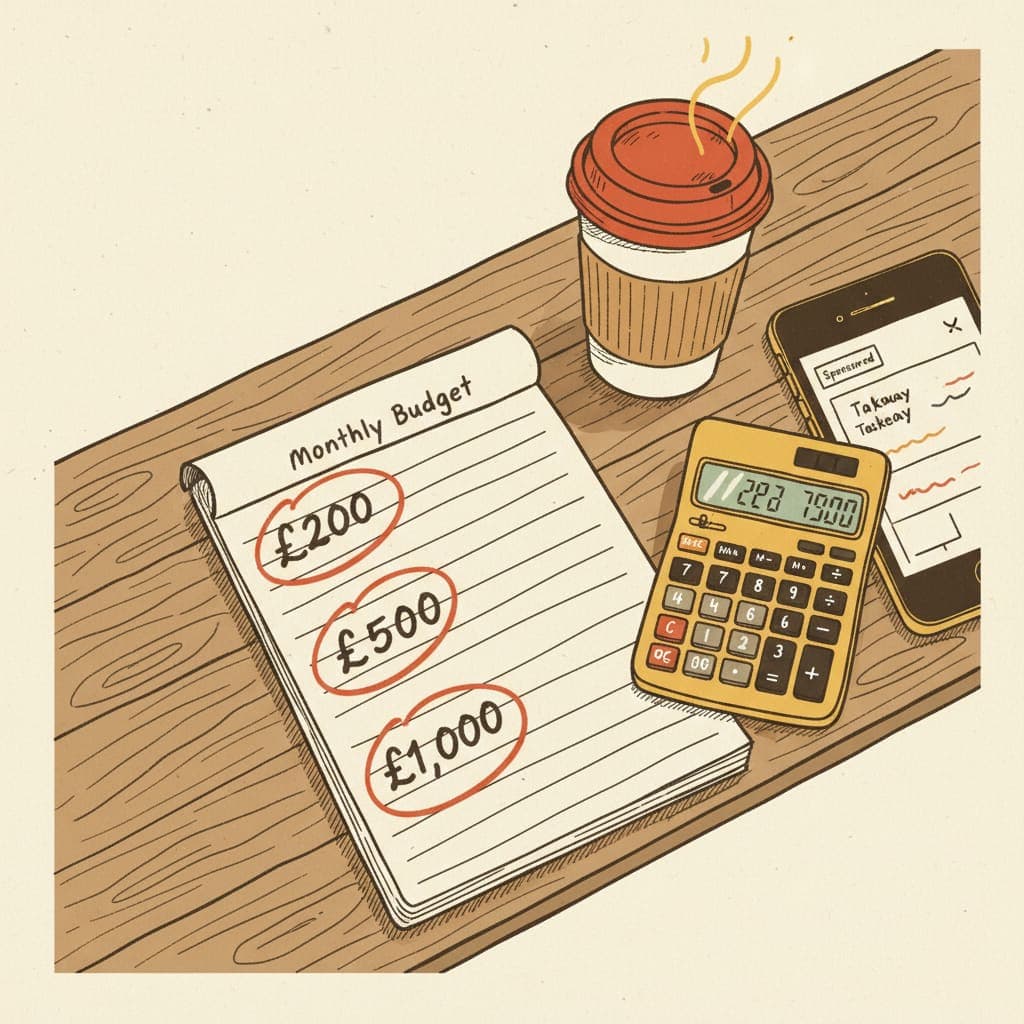
The honest one-line answer most owners never get: most independent UK restaurants and takeaways spend between £200 and £1,500 a month on Google Ads, including management. A few sit either side of that range — the ones spending under £150 are usually wasting it, and the ones above £2,000 are typically multi-location or in central London with a delivery operation.
This guide walks through what actually goes into that monthly number, what £200, £500 and £1,000 budgets each deliver, the hidden costs nobody mentions, and three quick checks to tell whether you're overspending right now. We run Google Ads for restaurants ourselves through our Google Ads service, so we have a vested interest — the goal here is that you walk away knowing whether you need us, a cheaper option, or no Google Ads at all.
The honest one-line answer
If a takeaway owner asks "what should I be spending?", the answer that fits 80% of cases is: £300–£600 a month of ad spend, plus £150–£300 management, plus a one-off £200–£800 setup. So roughly £450–£900/month all-in.
Adjust up if you're in central London, Manchester city centre, or another high-CPC area. Adjust down if you're in a smaller town with cheaper clicks.
What that £450–£900/month should buy you, for a typical UK takeaway run properly: 12–25 attributable orders a month from ads, plus a meaningful uplift in calls and direction requests that the platform won't directly attribute but the till will.
Anyone telling you a confident exact "£200 means X orders" is guessing. There are too many variables — your average order value, your conversion rate, your delivery radius, your competitors' bids, what hours you bid in.
What you're actually paying for (the cost stack)
When a marketing agency quotes "Google Ads — £600/month", that figure is almost always the management fee, not the ad spend. Google Ads has three separate costs and most owners only see one of them on the invoice.
The three layers:
- Ad spend. Money paid directly to Google for clicks. Usually charged to a card you own. This is the only layer that actually buys clicks.
- Management. What you pay the agency or freelancer running the account. Usually 15–25% of ad spend, with a minimum monthly retainer of £150–£300. Independent freelancers typically charge less than agencies.
- Setup, landing page, tracking. Often a one-off £200–£800. Covers the campaign build, conversion tracking, a fast landing page if your current site is slow, and call-tracking if you want to track phone calls properly.
A good agency will be transparent about all three. If you're being quoted "£500/month — everything included" with no breakdown, ask for one. You want to know how much actually goes to Google as click spend, because that's the only layer that buys orders.
What a click actually costs in the UK
Cost-per-click (CPC) for UK restaurant and takeaway search ads in 2026 sits roughly in this range, based on WordStream's industry benchmarks and our own client data:[2]
| Area | Typical CPC for "indian takeaway near me" or similar |
|---|---|
| Central London / Westminster | £2.80–£4.50 |
| Outer London / large city centres (Birmingham, Manchester) | £1.50–£2.80 |
| Mid-sized cities (Leicester, Bradford, Glasgow) | £0.90–£1.80 |
| Market towns and suburbs | £0.50–£1.20 |
| Quiet rural areas | £0.30–£0.80 |
A few caveats. CPC fluctuates with time of day (Friday 6–9pm is much more expensive than Tuesday lunch), cuisine type (Indian and pizza queries are competitive almost everywhere), and competitor activity. Local Services Ads — the green-tick pay-per-lead format Google rolled out for UK restaurants in 2024 — charge per lead rather than per click, typically £4–£12 per call or message.[1]
A practical implication: a £300/month budget in central London buys around 80 clicks. The same £300 in a market town buys around 400 clicks. That's why "what should I spend?" can't be answered without your postcode.
£200/month — what this realistically buys
The bottom end of useful Google Ads spend. A £200 ad budget in a market town buys 200–400 clicks; in central London it buys 50–70.
Realistic expectations for a typical UK takeaway:
- 4–10 attributable orders a month from ads
- A modest uplift in calls and direction requests (not directly attributable but real)
- One ad group, one or two campaigns, basic conversion tracking
- No room for testing — you're funding the most obvious keyword and that's it
Where this works: a takeaway in a smaller UK town with low CPCs, a £25+ average order value, and 4-star+ Google reviews. The maths is tight but the spend roughly pays itself back.
Where this fails: in central London, in a competitive cuisine (pizza, Indian), or with a website that loads slowly. The clicks come in and they bounce. £200 buys you a learning curve, not orders.
If you're spending £200 a month and have been for six months with no attributable orders, stop. The money is being lit on fire.
£500/month — the most common bracket
This is where most of the takeaways we onboard end up. £500 of ad spend, plus £150–£200 management, totalling £650–£700/month all-in. We see good returns here for mid-sized cities.
What this buys:
- 12–20 attributable orders a month from ads
- Two or three campaigns: one for "near me" intent, one for branded ("[your name] menu"), one for offers and promotions
- A landing page that loads in under 2 seconds (Google rewards fast pages with cheaper clicks, and customers don't bounce)
- Proper call tracking, so you know which keywords drive phone orders too
- Enough data to run weekly tweaks rather than monthly guesses
This bracket starts to pay for the management fee through the orders it generates. A £25 average-order takeaway needs around 26 ads-driven orders a month to cover £650 of total spend — and at £500 ad spend in a mid-sized city that's achievable.
What you're still not getting at £500: shopping ads, YouTube remarketing, A/B testing of landing pages, or any meaningful presence outside your one or two most obvious keywords.
£1,000/month — when this earns its keep
A £1,000/month ad spend (so around £1,250 all-in with management) is roughly the point where Google Ads becomes a serious channel rather than a top-up.
At this level you should expect:
- 25–50 attributable orders a month from ads
- Multiple campaigns across Search, Performance Max, and remarketing
- Proper audience segments (first-time customers vs returning, by area)
- Landing-page split-testing (a different page for delivery vs collection vs catering)
- A weekly performance call or written update from whoever's managing it
This bracket suits busier independents doing £30,000+ in monthly delivery and collection revenue, where a 5–10% lift from ads is worth the spend.
It also starts to overlap with the maths of leaving Just Eat and going direct. If you're paying Just Eat £2,000/month in commission and Google Ads £1,250/month is driving the same number of orders direct to your own website, you're already winning — you keep the margin.
£2,000+/month — when this makes sense
Reserve this bracket for: multi-location takeaways, restaurants with catering or events revenue, or single-location operators in extremely competitive areas (central London, central Manchester, central Glasgow) where the cost-per-click leaves no choice.
What changes above £2,000:
- Multi-location targeting with one campaign per branch
- Cross-channel attribution (Google + Meta + Google Business Profile posts)
- A dedicated account manager rather than an account handler
- Custom audiences imported from your direct-ordering platform
- A real testing budget — typically 10–15% of total spend ring-fenced for experiments
Most independent takeaways don't need this and shouldn't be sold it. If an agency is quoting £2,500/month for one shop in a market town, walk away.
The hidden costs nobody mentions
Five recurring fees that don't appear on the agency's headline quote:
- Landing page work. If your website loads slowly, Google charges you more per click. Fixing a slow page might cost £400–£1,500 one-off. Without it, you're paying a 20–40% "slow site tax" on every click.[2]
- Call-tracking software. Tools like CallRail or Ringostat cost £30–£80/month per location and are how you know which keywords drive phone orders. Without it, half your ROI is invisible.
- Ad-spend ramp. New accounts have a "learning period" of 2–4 weeks where the algorithm is figuring out who to show your ads to. Spend in this window often underperforms by 30–50%.
- Promotional discounts. Many takeaways layer in "£3 off your first order" to make the ads convert. The discount comes out of your margin, not the agency's.
- Tracking setup. Done properly (server-side conversion tracking, GA4, Google Search Console) the setup is a one-off £300–£600. Done badly or skipped, you're flying blind.[5]
A clear quote breaks all five out. If yours doesn't, ask for them.
What management fees should — and shouldn't — cover
A fair Google Ads management fee for a single-location UK takeaway sits at £150–£300/month. That should cover:
- Weekly checks on the account (not just monthly)
- Negative-keyword expansion (stopping ads showing for irrelevant searches)
- Bid adjustments by time of day, device, and location
- Ad-copy refresh once a month
- A monthly report you can actually read, not a 30-page PDF
- A 30-minute monthly call to explain what changed
What it should not cover (i.e. expect to pay extra for):
- A new landing-page build
- A website rebuild
- Local SEO work (different discipline — that lives in Local SEO)
- Social media posting
- Photography or graphic design
Beware "all-in £600/month" packages that promise Google Ads, SEO, social media, website management and design. None of those get done well in £600.
Three signs you're overspending right now
Quick health check. If two or more of these apply, your spend is leaking:
- Your conversion tracking shows zero or single-digit orders/month after 60 days. Either the tracking is broken (most common) or the ads aren't working. Investigate before adding budget.
- Your top three keywords in the search-terms report are your own brand name. That's expensive remarketing pretending to be acquisition. Real acquisition keywords look like "indian takeaway near me" or "delivery [your area]".
- You're bidding on weekday lunch (Mon–Thu, 11am–2pm) when your kitchen barely covers cost at lunch. Cut the time slot, redirect the saved spend to Fri/Sat 6–10pm.
If all three apply: pause the account, fix tracking, and restart with half the budget.
FAQ
Is Google Ads cheaper than Just Eat commission? For most UK takeaways doing £15,000+/month, yes — once you account for promo discounts and sponsored placements, the all-in cost of Just Eat runs around 31% of gross delivery revenue. A £1,000/month Google Ads spend at 20% on £30,000 revenue works out far better. But Google Ads doesn't pre-bring you traffic — it competes for it. Both channels have a place.
Can I run Google Ads myself without an agency? Yes — and many owners do. Plan around 4 hours/week for the first six weeks, then around 1 hour/week ongoing. The hardest parts are conversion tracking and writing ads that don't waste budget. If you can spare the time, our wider Google Ads guide for takeaways explains the four ad formats and when each is right.
How long until Google Ads starts working? Realistic timeline: 2–3 weeks of underperformance while the account learns, then 4–6 weeks of optimisation before you have a clean baseline. Three months to confidently say "this is or isn't working" for your specific shop.
Do I need a website to run Google Ads? Yes. Google Ads requires a destination, and a Google Business Profile on its own won't do it. If your site is a Wix template under 18 months old it's probably fine; if it's a 2018 WordPress site that loads in 8 seconds, fix that first — our guide on what a UK restaurant website should cost covers options.
Should I try Local Services Ads instead of regular Search Ads? Local Services Ads (the green-tick pay-per-lead format) are now available for UK restaurants in major cities.[1] They convert well for collection-heavy takeaways. The catch is approval and reviews — they require Google Business Profile verification and pause if your rating dips below 4.0. For most takeaways, run them alongside Search Ads rather than instead of them.
The honest summary
If you're a single-location UK takeaway and someone is quoting more than £1,200/month all-in for Google Ads, push back. If they're quoting under £400/month all-in, ask what corners are being cut (usually: zero management, broken tracking, no landing-page work).
The right number for most independents is £450–£900/month all-in, of which £300–£600 is real ad spend, £150–£300 is management, and the rest covers tracking and landing-page work. Add a one-off £200–£800 setup at the start.
What to do this week, if you currently run ads:
- Pull your last 60 days of conversion data. If it shows zero orders, your tracking is broken.
- Check your search-terms report. Pause anything irrelevant.
- Look at the time-of-day report — cut the slots where your kitchen doesn't make money.
- If you're paying more than 25% of ad spend in management, get a second quote.
And if you don't currently run ads — and you're spending £1,500+/month on Just Eat sponsored placements — diverting half of that into a small Google Ads test for 90 days is usually the right experiment.
Sources & further reading
We help UK restaurants and takeaways grow online. Get in touch for a free audit.